
Protein Labeling Reagents


AdipoGen 5-TAMRA N-succinimidyl ester
Chemical. CAS 150810-68-7. Formula C29H25N3O7. MW 527.52. Synthetic. Amine-reactive form of 5-carboxytetramethylrhodamine single isomer. Conjugates yield bright, pH-insensitive orange-red fluorescence Ex/Em ~546/579nm with good photostability.

Biotium CD22(FR10B4), CF568 conjugate, 0.1mg/mL
Recognizes a protein of 130-140 kDa, identified as CD22 (also known as BL-CAM). CD22 expression is restricted to normal and neoplastic B cells and is absent from other haemopoietic cell types. In B-cell ontogeny, CD22 is first expressed in the cytoplasm of pro-B and pre-B cells, and on the surface as B cells mature to become IgD . It is not expressed by plasma cells, CD22 is found highly expressed in follicular mantle and marginal zone B-cells, and while germinal center B-cells are relatively weak. CD22 is a member of the immunoglobulin superfamily and serves as an adhesion receptor for sialic acid-bearing ligands expressed on erythrocytes and all leukocyte classes. It also associates with tyrosine kinases and play a role in signal transduction and B-cell activation.Primary antibodies are available purified, or with a selection of fluorescent CF Dyes and other labels. CF Dyes offer exceptional brightness and photostability. Note: Conjugates of blue fluorescent dyes like CF
Biotium Chromogranin A(CHGA/413), CF568 conjugate, 0.1mg/mL
Chromogranin A is present in neuroendocrine cells throughout the body, including the neuroendocrine cells of the large and small intestine, adrenal medulla and pancreatic islets. It is an excellent marker for carcinoid tumors, pheochromocytomas, paragangliomas, and other neuroendocrine tumors. Co-expression of chromogranin A and neuron specific enolase (NSE) is common in neuroendocrine neoplasms. Reportedly, co-expression of certain keratins and chromogranin indicates neuroendocrine lineage. The presence of strong anti-chromogranin staining and absence of anti-keratin staining should raise the possibility of paraganglioma. The co-expression of chromogranin and NSE is typical of neuroendocrine neoplasms. Most pituitary adenomas and prolactinomas readily express chromogranin.Primary antibodies are available purified, or with a selection of fluorescent CF Dyes and other labels. CF Dyes offer exceptional brightness and photostability. Note: Conjugates of blue fluorescent dyes
Biotium CD3e(RIV9), CF568 conjugate, 0.1mg/mL
Reacts with five invariable CD3 chains designated CD3y, CD3d, CD3e, CD3f, and CD3n with molecular weight ranging from 16-28 kDa. CD3, also known as T3, is a member of the immunoglobulin superfamily that plays a role in antigen recognition, signal transduction, and T cell activation. It is found on all mature T-lymphocytes, NK, T-cells, and some thymocytes. It is expressed, typically at high levels, on peripheral T cells and majority of T cell neoplasms. Thymocytes express CD3 at different level on the cell surface in the course of differentiation and, in cortical thymus, CD3 is predominantly intracytoplasmic. This MAb is particularly useful for induction of T cell activation in vitro and in vivo due to its unusual IgG3 isotype.Primary antibodies are available purified, or with a selection of fluorescent CF Dyes and other labels. CF Dyes offer exceptional brightness and photostability. Note: Conjugates of blue fluorescent dyes like CF405S and CF405M are not recommend
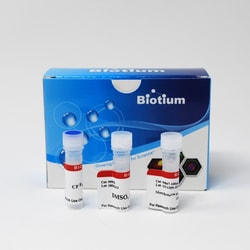
Biotium MemBrite™ Fix 594/615 Cell Surface Staining Kit, 100 Reactions
MemBrite™ Fix Cell Surface Staining Kits are designed for covalently staining the surface of live cells to conveniently visualize cell boundaries in immunofluorescence experiments. MemBrite™ Fix are new covalent cell surface stains that react irreversibly with cell surface proteins for staining that can withstand formaldehyde or alcohol fixation, and detergent permeabilization. Unlike lectins such as WGA, which bind specific targets that may vary between cell types, MemBrite™ Fix dyes react widely with cell surface proteins. MemBrite™ Fix staining is rapid and non-toxic to cells, and because MemBrite™ Fix dyes are highly water soluble, they stain cells much more evenly than traditional lipophilic membrane dyes like DiO, DiI, PKH, Vybrant, or CellMask™. This trial size kit has reagents sufficient for 100 labeling reactions. The kit contains 1 vial of MemBrite™ Fix 594/615 that is sufficient for 20 uL of 1000X dye after DMSO reconstitution.
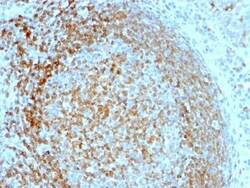
Biotium CD74(LN-2), CF488A conjugate, 0.1mg/mL
This antibody recognizes a protein of ~35 kDa, identified as CD74 (Workshop IV). CD74 is a type II transmembrane protein which binds to the peptide binding groove of newly synthesized MHC class II alpha/beta heterodimers and prevents their premature association with endogenous polypeptides. CD74 is expressed primarily by antigen presenting cells, such as B-lymphocytes (from before the pre-B cell stage to before the plasma cell stage), macrophages, and monocytes, and many epithelial cells. Anti-CD74 stains predominantly germinal center lymphocytes and B-cell lymphomas, but rarely T-cell lymphomas. Anti-CD74 has been shown to be useful in differentiating atypical fibroxanthoma (-) from malignant fibrous histiocytoma ( ).Primary antibodies are available purified, or with a selection of fluorescent CF Dyes and other labels. CF Dyes offer exceptional brightness and photostability. Note: Conjugates of blue fluorescent dyes like CF405S and CF405M are not recommended for detecti
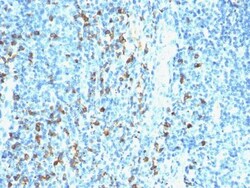
Biotium Biotin(Hyb8), CF488A conjugate, 0.1mg/mL
This antibody recognizes both the free and protein-conjugated (either soluble or cell bound) form of biotin. This MAb is highly specific to biotin and shows no cross-reaction with other structurally related compounds. It has a very high affinity for biotin and is excellent for use in various amplification techniques. In some applications, localization of biotinylated probes with avidin produces unacceptably high background staining. Anti-biotin antibody may be substituted to decrease this noise.Primary antibodies are available purified, or with a selection of fluorescent CF Dyes and other labels. CF Dyes offer exceptional brightness and photostability. Note: Conjugates of blue fluorescent dyes like CF405S and CF405M are not recommended for detecting low abundance targets, because blue dyes have lower fluorescence and can give higher non-specific background than other dye colors.
Biotium MUC2(CCP58), CF488A conjugate, 0.1mg/mL
Recognizes a single glycoprotein of 520 kDa, identified as mucin 2 (MUC2). This MAb shows no cross-reaction with human milk fat globule membranes, MUC1, or MUC3. Its epitope has been defined as GTQTP (GlyThrGlnThrPro). Mucins are high molecular weight glycoproteins, which constitute the major component of the mucus layer that protects the gastric epithelium. MUC2 is specifically expressed in goblet cells of the small intestine & colon; in about 65% of colonic carcinomas and about 40% of gastric carcinomas. MUC2 is rarely expressed outside of the GI tract with the exceptions of mucinous carcinoma of breast and clear cell-type carcinomas of the ovary.Primary antibodies are available purified, or with a selection of fluorescent CF Dyes and other labels. CF Dyes offer exceptional brightness and photostability. Note: Conjugates of blue fluorescent dyes like CF405S and CF405M are not recommended for detecting low abundance targets, because blue dyes have lower fluoresc
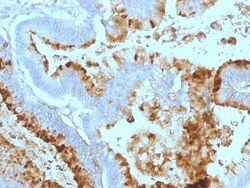
Biotium Lewis A(7LE), CF568 conjugate, 0.1mg/mL
Recognizes a carbohydrate determinant of Gal 1-3(Fuc 1-4) GlcNAc which is blood group antigen Lewis A. It is present primarily on epithelial cells such as colon and kidneys. In the tumors and dedifferentiated tissues, decrease of Lewis A antigen was observed. Lewis A (type 1 chain) is expressed in colonic epithelial cells and may be useful for detection of gastrointestinal tumors, pancreatic cancer, and colorectal tumors. Blood group related antigens represent a group of carbohydrate determinants carried on both glycolipids and glycoproteins. They are usually mucin-type, and are detected on erythrocytes, certain epithelial cells, and in secretions of certain individuals. Sixteen genetically and biosynthetically distinct but inter-related specificities belong to this group of antigens, including A, B, H, Lewis A, Lewis B, Lewis X, Lewis Y, and precursor type 1 chain antigens.Primary antibodies are available purified, or with a selection of fluorescent CF Dyes and other labels
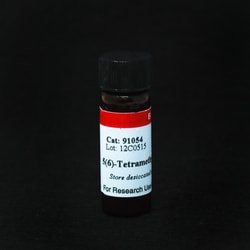
Biotium 5(6)-Tetramethylrhodamine Maleimide
5(6)-Carboxytetramethylrhodamine maleimide has C6-linker that enhances the fluorescence after the dye is conjugated to proteins. The product is a direct replacement for 5(6)-carboxytetramethylrhodamine C5-maleimide (91040).Properties: Ex/Em (MeOH) = 540/565 nm; Red solid soluble in DMF or DMSO; Store at -20°C and protect from light, especially in solution; C35H36N4O6; MW: 608.66.
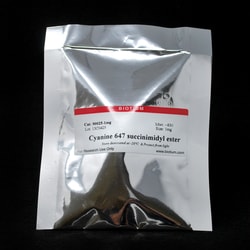
Biotium Cyanine 647 Succinimidyl Ester
Biotium offers high quality amine-reactive succinimidyl ester (SE, or NHS-Ester) dyes used to label proteins, oligonucleotides, and nucleic acids. We offer Cyanine 555 (Cy3), Cyanine 647 (Cy5), Cyanine 770 (Cy5.5), and Cyanine 750 (Cy7) as high quality succinimidyl esters. Also see our CF Dye Succinimidyl Ester, available with more than 20 bright and photostable CF Dyes. Cyanine 647 is structurally identical to Cy5 from GE Healthcare. Properties: Ex / Em (water) = 650/665 nm; Dark blue solid soluble in DMF and DMSO; Store at -20°C and protect from moisture and light; C 43 H 58 N 4 O 10 S 2; MW: 855. Cy3, Cy5, Cy5.5, and Cy7 are registered trademarks of GE Healthcare.
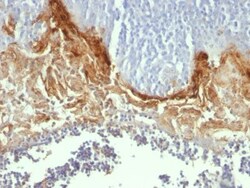
Biotium Involucrin(SY5), CF488A conjugate, 0.1mg/mL
This antibody recognizes a protein of 66 kDa-170 kDa, identified as involucrin. In Western blotting of cultured human keratinocytes, this MAb reacts with a 120 kDa protein. It stains the involucrin in a variety of sizes: 170 kDa in MCF-7 cells, a doublet of ~115 kDa and 150 kDa in gorilla and owl monkey, 66 kDa in dog, and a doublet of 105 kDa in pig. Its epitope maps between codon 421-568 of human involucrin. Involucrin is expressed in a range of stratified squamous epithelia, including the cornea, which lacks a distinct cornified layer. In normal epidermis, it is first expressed in the upper spinous layers, and in keratinocyte cultures, all cells that have left the basal layer express it. Involucrin expression is altered in pathological conditions: in psoriasis and other benign epidermal hyperplasias, involucrin expression begins closer to the basal layer than normal; expression is abnormal in squamous cell carcinomas and premalignant lesions, and is reduced in severe dyspl